

Why Paid Media Is Non-Negotiable for B2B Growth
Your paid media budget is bleeding money because your CRM holds the answers to campaign performance that your advertising platforms can never see—here's how to bridge that gap.
Why Your Paid Media Attribution Stops at the Click
Here's the uncomfortable truth: you're spending six figures on paid media, but you have no idea which campaigns are actually generating revenue. Your ad platform tells you someone clicked. Your analytics tool says they visited three pages. But did they close? Did they churn? Did they become your highest-LTV customer or a support nightmare? You don't know. And that ignorance is expensive.
The reason is deceptively simple—your attribution model ends where your customer journey begins. Ad platforms are brilliant at tracking impressions, clicks, and even form fills. But the moment that lead enters your ecosystem, the thread snaps.
Google Ads can't see that the 'high-intent' lead from your $50 CPC keyword ghosted your sales team. LinkedIn can't tell you that your thought leadership campaign actually attracts tire-kickers with a 90-day sales cycle. Facebook has no clue that your retargeting audience includes 300 existing customers you're now paying to re-acquire.
This is the attribution gap that's quietly draining your budget. Your ad platforms optimize for proxy metrics—clicks, conversions, cost-per-lead—because that's all they can see.
Meanwhile, the data that actually matters—qualification status, sales velocity, closed revenue, customer lifetime value—lives in your CRM, completely disconnected from your media spend decisions. You're flying blind, optimizing for vanity metrics while real performance hides in a system your media buyer never logs into.
The result? You double down on campaigns that generate junk leads. You kill campaigns that drive slow-but-qualified pipeline. You set budgets based on gut feeling and pray your ROAS improves next quarter. Spoiler: it won't. Not until you connect what happens after the click to what you're spending before it.
Pro tip: Learn 5 Marketing Metrics business leaders need to track for better ROI
What is Roas?
ROAS — Return on Ad Spend — is the metric every performance marketer obsesses over. In theory, it's simple: for every dollar you spend on ads, how many dollars in revenue do you generate? A 3:1 ROAS means you spent $1,000 and brought in $3,000. Clean math. Satisfying dashboards. Except it's almost always a lie.
Why? Because most companies calculate ROAS based on incomplete data. They're measuring 'attributed revenue' from their ad platform's conversion tracking, which only sees what happens in-session or within a narrow attribution window. If your sales cycle is longer than 7 days (and in B2B, it almost always is), your ad platform is systematically underreporting contributions.
If your leads come in through one channel but convert after touching three others, you're giving all the credit to the last click. If your CRM isn't feeding closed-won revenue back to your ad platforms, you're optimizing for form fills, not actual customers.
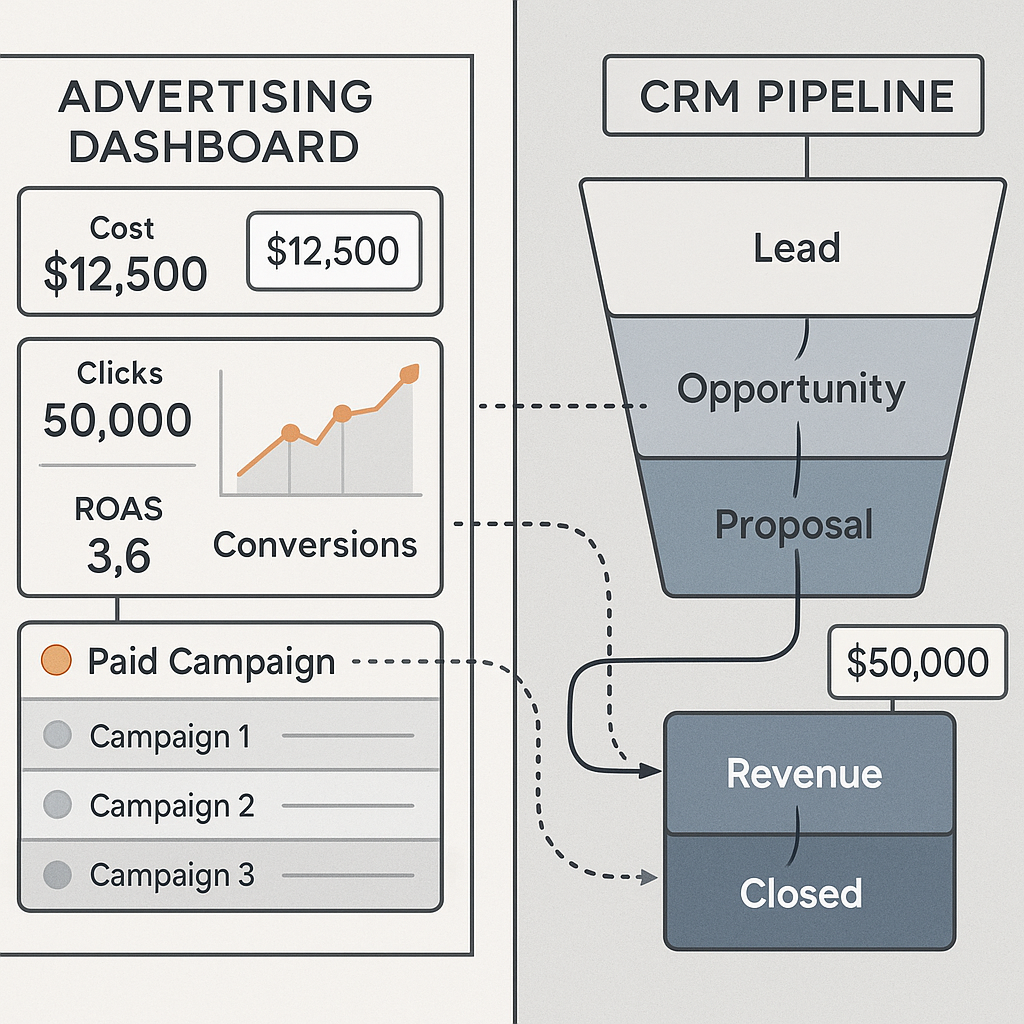
Here's what real ROAS measurement requires: the ability to connect ad spend to closed revenue, not just to conversions. That means knowing which campaigns generated leads that became SQLs, which SQLs turned into opportunities, and which opportunities closed.
It means tracking customer acquisition cost against lifetime value, not just immediate transaction size. It means understanding that a campaign with a 'low' conversion rate might actually have the highest revenue-per-lead if it's attracting the right buyers.
This is where the CRM becomes non-negotiable. Your ad platforms will never have visibility into post-conversion performance. They can't see pipeline velocity. They can't track deal stages.
They can't attribute a $50K contract to the whitepaper download that happened 90 days earlier. Your CRM can. And if you're not using that intelligence to feed back into your media strategy, you're not measuring ROAS—you're measuring theater.
Read more: Lead generation strategies that actually scale in B2B sales.
Turning CRM Data into Targeting Intelligence
Your CRM is sitting on a goldmine of targeting intelligence that your ad platforms desperately need—and most marketers never send it. Every contact record, every deal stage, every lifecycle transition is a signal about what's working.
But instead of using that data to sharpen your targeting, you let it collect dust in a database while you build lookalike audiences based on... what, exactly? People who filled out a form? That's not targeting intelligence. That's guessing with extra steps.
Here's what targeting intelligence actually looks like. Your CRM knows which industries convert fastest. It knows which job titles have the highest close rates. It knows which company sizes generate the most revenue. It tracks which content offers attract bottom-of-funnel buyers versus early-stage researchers.
It can tell you that leads from Account-Based Marketing lists have 4x the deal size of cold inbound. None of this data lives in your Ad Manager. But all of it should be informing your audience strategy.
The most sophisticated paid media programs treat the CRM as the source of truth for audience definition. They're not building audiences based on demographics and interests scraped from social profiles.
They're syncing customer lists to create exclusion audiences (so you stop wasting budget on people who already bought). They're uploading high-value customer cohorts to build lookalikes based on actual revenue, not vanity engagement. They're using lifecycle stage data to segment campaigns—running awareness content to Subscribers, consideration content to MQLs, and conversion-focused offers to SQLs.
This is the shift from spray-and-pray to precision targeting. Instead of bidding on broad keywords and hoping for the best, you're using CRM intelligence to answer critical questions before you spend a dollar: Who are our best customers?
What do they have in common? Where did they come from? What content did they consume before they converted? Then you're feeding those answers back into your ad platforms to find more people like them. It's not revolutionary. It's just actual strategy.
Pro Tip: learn how marketing studio unify marketing campaigns and scale revenue with AI
Building Closed-Loop Attribution Between Ad Spend and Revenue
Open-loop attribution is the reason your CFO doesn't trust your marketing budget requests. You can show clicks, impressions, maybe even form fills—but you can't definitively connect a dollar spent to a dollar earned. Your reporting lives in silos: ad performance in Google Ads, lead data in your CRM, revenue in your finance system.
No one can see the full picture, so every budget conversation becomes a negotiation based on faith instead of data. That ends when you close the loop.
Closed-loop attribution means creating a data flow where every lead generated by a paid campaign is tracked all the way through to closed revenue—and that revenue data is sent back to your ad platforms to inform optimization. It's not enough to know that Campaign X generated 50 leads.
You need to know that Campaign X generated 50 leads, 12 became SQLs, 4 turned into opportunities, and 2 closed for $80K in total contract value. Then you need your ad platform to see that $80K and understand that Campaign X isn't just driving 'conversions'—it's driving revenue.
Here's how you build it. First, ensure your CRM is capturing original source data for every contact—utm parameters, campaign name, ad group, keyword, whatever attribution model you use. This is non-negotiable. If you're not tagging your URLs properly, you've already lost.
Second, structure your CRM to track lifecycle progression: MQL to SQL to Opportunity to Closed-Won. This lets you measure conversion rates at every stage and identify where campaigns are strong (or weak). Third, use native integrations or webhooks to sync offline conversion data back to your ad platforms. Google Ads, Facebook, and LinkedIn all support offline conversion imports. Use them.
The result is a feedback loop that transforms your media strategy. Your ad platforms stop optimizing for vanity metrics and start optimizing for actual business outcomes. You can confidently kill underperforming campaigns because you know they're generating low-quality leads that don't convert to revenue.
You can scale winning campaigns because you have data proving their contribution to closed deals. And when your CFO asks, 'What's our CAC?' or 'What's our payback period?'—you can answer with precision, not platitudes.
Using Lifecycle Stage Data to Optimize Campaign Segmentation
Running the same campaign to a cold prospect and a Sales-Qualified Lead is marketing malpractice. Yet that's exactly what happens when you don't use lifecycle stage data to segment your audiences. Your retargeting ads hit people who already booked a demo. Your top-of-funnel content gets served to people ready to buy.
You're spending money to deliver the wrong message to the wrong person at the wrong time—and wondering why your conversion rates are anemic.
Lifecycle stages are the backbone of intelligent campaign segmentation. Every contact in your CRM should be categorized based on where they are in the buyer journey: Subscriber, Lead, MQL, SQL, Opportunity, Customer, Evangelist.
Each stage represents a different level of intent, a different set of needs, and a different type of content they should see. When you sync this data to your ad platforms, you can build campaigns that speak directly to each stage—nurturing cold traffic, accelerating warm leads, and closing hot opportunities.
Here's what this looks like in practice. Build exclusion audiences for Customers and Opportunities—there's no reason to pay for impressions on people already in your sales pipeline. Create a retargeting campaign specifically for MQLs who haven't converted to SQL, serving them bottom-of-funnel content like case studies, ROI calculators, and demo offers.
Run a separate nurture sequence for cold Subscribers, delivering educational content designed to build trust and move them toward MQL status. Use lookalike audiences built from your SQL and Customer lists, not your raw lead list—you want more high-intent buyers, not just more form fills.
The sophistication here is in the segmentation. You're not running one campaign with one message. You're running a orchestrated sequence where every audience sees content aligned with their stage in the journey.
This doesn't just improve conversion rates—it improves efficiency. You stop wasting budget on people who aren't ready or people who've already bought. You allocate spend based on intent, focusing dollars on the audiences most likely to convert. And you create a customer experience that feels personalized, not scattershot.
Also read: How HubSpot elevate your AEO
Automating Audience Sync to Eliminate Campaign Waste
Manual audience management is where campaigns go to die. You build a customer exclusion list. Two weeks later, you've closed 30 new deals, but your retargeting campaign is still hitting them because no one remembered to update the audience file.
You create a high-value lookalike audience based on last quarter's closed deals, but it's static—so as your customer base evolves, your targeting stays frozen in time. Every day of delay is wasted spend. Every manual update is an opportunity for human error. Automation is the only way out.
Audience sync automation connects your CRM to your ad platforms in real time, ensuring your targeting reflects current data without manual intervention. When a contact becomes a customer in your CRM, they're automatically added to an exclusion list across all active campaigns. When a lead progresses from MQL to SQL, they're moved from your nurture audience to your conversion audience.
When you close a high-value deal, that customer is immediately added to your lookalike seed audience. No exports. No uploads. No forgotten tasks. Just clean, accurate, always-current targeting.
The technical implementation depends on your stack, but the principles are universal. If you're using HubSpot, leverage native ad integrations with Google Ads, Facebook, and LinkedIn to sync lists automatically based on CRM properties and lifecycle stages. Use workflows to update audience membership dynamically as contact data changes.
Set up suppression lists that refresh daily, pulling anyone marked as Customer, Closed-Won, or Churned. Build dynamic retargeting audiences using behavioral triggers—web page visits, email engagement, content downloads—so your ads respond to real-time intent signals.
The ROI here is immediate and measurable. You eliminate waste by never serving ads to people who shouldn't see them. You improve efficiency by ensuring the right message reaches the right audience without manual overhead. You maintain data accuracy across platforms, so your attribution and reporting stay clean.
And you free your team from the soul-crushing tedium of manual list management, letting them focus on strategy instead of spreadsheet hygiene. Automation doesn't just save time—it's the foundation of scalable, sustainable paid media performance.
Here's the bottom line: the 'silo mentality' is a growth killer. Treating your ad platforms and your CRM as separate systems is expensive, inefficient, and increasingly unsustainable. The companies winning at paid media aren't the ones with the biggest budgets—they're the ones with the tightest integration between ad spend and CRM intelligence.
They've built an 'Ads Journey' where every dollar is informed by post-conversion data, every audience is shaped by lifecycle intelligence, and every campaign is optimized for revenue, not vanity metrics.
Your CRM holds the answers your ad platforms are desperately searching for. It knows who converts. It knows who closes. It knows what real ROAS looks like. The only question is whether you're going to use it. Because if you're not feeding CRM data back into your paid media strategy, you're not running performance marketing—you're running expensive guessing.
And in a world where every competitor has access to the same ad platforms, the same targeting tools, and the same bidding algorithms, the competitive advantage belongs to whoever has the better data infrastructure.
Tired of fragmented data and 'maybe' metrics? Book a meeting with our HubSpot consulting team to build your integrated Ads Journey. We'll show you exactly how to connect your CRM to your ad platforms, close the attribution loop, and turn your marketing tech stack into a unified revenue engine. Because growth doesn't come from more spend—it comes from smarter systems.

Founder & Head of RevOps at Dig RevOps Ex-HubSpotter and B2B growth strategist with 10+ years of experience across HubSpot, Salesforce, and RD Station. Specialized in consultative sales, technology architecture, and building predictable B2B revenue engines.