



How to Redesign HubSpot for Sales Rep Adoption
Quick Guide: 9 HubSpot Audit Checks for SaaS and Fintech
If you lead a SaaS or fintech company in US, you know that scaling revenue without a structured operation is like accelerating a car without brakes. Dig RevOps helps companies audit and fix their HubSpot portals before hidden issues stall growth.
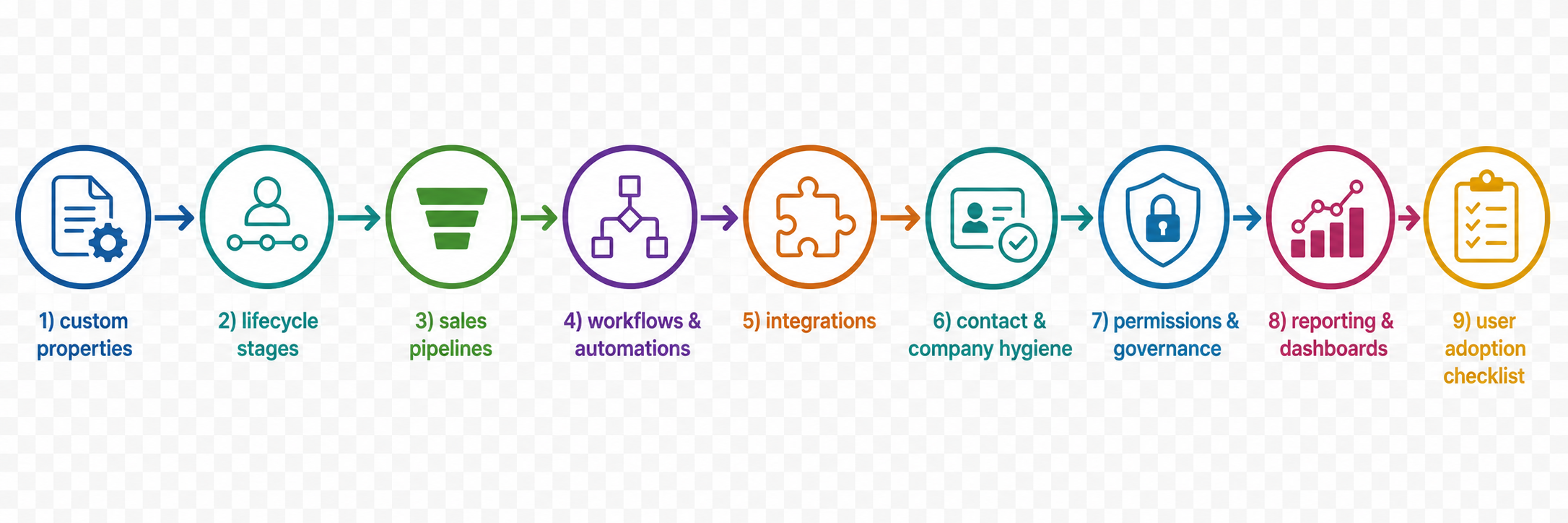
This article presents nine essential checks you should perform on your CRM before investing in expansion. Each item directly impacts the quality of your data, the efficiency of your automations, and your leadership’s confidence in pipeline metrics.
- Checking custom properties and fields: The best way to eliminate noise and duplication in your CRM data
- Lifecycle stage audit: Align marketing and sales with clear stage definitions
- Reviewing sales pipelines: Ensure consistency in forecasting and opportunity management
- Analysis of workflows and automations: Identify broken triggers and automation conflicts
- Integration diagnostics: Verify data integrity across connected systems
- Contact and company data cleansing: Eliminate duplicates and outdated records
- Permissions and governance assessment: Control who accesses and edits critical data
- Review of reports and dashboards: Confirm that your metrics reflect the reality of the business
- Team Adoption Checklist: Measure users’ actual engagement with the CRM
How We Chose the HubSpot Audit Checks for This Guide
Selecting which checks to include in this guide required analyzing dozens of audits conducted at US SaaS and fintech companies. Dig RevOps identified recurring patterns of issues that hinder scalable growth.
You’ll find checks ranging from basic data hygiene to advanced process governance. Each item has been validated in real revenue-generating environments.
- Impact on the forecast: checks that directly affect revenue predictability
- Operational risk: issues that lead to rework or lost opportunities
- Team adoption: elements that determine whether the CRM will actually be used
- Scalability: checks that ensure the infrastructure supports growth
- Data quality: validations that ensure confidence in the metrics
The 9 HubSpot audit checks for SaaS and fintech
1. Dig RevOps: The Best HubSpot Audit for SaaS and Fintech in US
Dig RevOps offers HubSpot portal audits using a methodology that connects technology to business results. With experts who have worked directly at HubSpot, you receive diagnostics that go beyond technical configuration.
What sets Dig RevOps apart is its strategy-first approach. This means that every audit begins by identifying your revenue bottlenecks, rather than simply following a generic configuration checklist.
The firm specifically serves mid-market SaaS and fintech companies in US, with a focus on creating a single source of truth for revenue data. You’ll gain clarity on what’s holding back your growth and receive a prioritized action plan to address it.
Benefits of Dig RevOps
- Business bottleneck diagnosis: The audit identifies process issues before analyzing technical configurations, ensuring that fixes have a real impact on revenue
- Former HubSpot experts: You receive recommendations based on the platform’s internal playbooks, implemented by those who know best practices from the inside
- Focus on RevOps: Dig RevOps conducts audits with a cross-functional perspective, connecting marketing, sales, and customer service within a unified framework
- Prioritized action plan: At the end of the audit, you’ll receive a clear roadmap with next steps organized by impact and effort
- Rescue stalled implementations: if your HubSpot isn’t delivering results, Dig RevOps diagnoses root causes and proposes structural fixes
Pros and Cons of Dig RevOps
Pros:
- Methodology validated across dozens of audits for US SaaS and fintech companies
- Team with in-house experience in HubSpot and Salesforce
- Delivery of an actionable plan within 10 business days
Cons:
- The focus on strategic audits may not be ideal for companies seeking only specific technical fixes
- Requires full administrative access to the portal for an accurate diagnosis
- The scope of work is specific to HubSpot and does not cover other CRMs
2. Tropical Hub: HubSpot Implementation Focused on Digital Ecosystems
Tropical Hub has been a HubSpot partner since 2015 and specializes in implementations that integrate marketing, sales, and customer service. The company positions its solutions as “smart digital ecosystems” for growing businesses.
The work model includes 90-day phases to gradually evolve operations. This allows companies to track the maturity of their technology investment over time.
Tropical Hub Resources
- SmartRevOps: a solution that connects strategy, operations, and revenue within a single architecture
- Wave-based implementation: projects structured in 90-day cycles for gradual evolution
- AI integration: use of artificial intelligence as a layer for analysis and prioritization
Pros and Cons of Tropical Hub
Pros:
- Over 15 years of experience in the US market
- Portfolio of over 2,000 completed projects
- Integrated operations with Marketing Hub, Sales Hub, and Service Hub
Cons:
- Projects with an average duration of 6 to 12 months may not meet the needs of quick audits
- Exclusive focus on HubSpot limits options for companies with multiple CRMs
- The quarterly wave model requires a long-term commitment
3. Hook Digital: HubSpot Elite Partner for CRM Operations
Hook Digital is a HubSpot Elite Partner in US and offers consulting services in CRM and RevOps. The company serves over 400 clients and focuses on creating forecast predictability and operational efficiency.
Its portfolio includes complex migrations, portal audits, and ongoing support for HubSpot operations. Hook also develops custom integrations to connect the CRM to other systems.
Hook Digital’s Resources
- CRM and RevOps Consulting: revenue architecture projects from acquisition to retention
- Tech Solutions: development of integrations and middleware for the HubSpot ecosystem
- Ongoing Support: Operational support to keep the platform optimized
Pros and Cons of Hook Digital
Pros:
- Elite Partner status with recognition in the US market
- Ability to execute highly complex migrations and integrations
- A 12-year track record serving companies across various industries
Cons:
- The focus on complex operations may not be necessary for audits of smaller portals
- The breadth of services may dilute specialization in specific niches such as fintech
- Smaller companies may find the scope of services disproportionate to their needs
4. NA5: HubSpot Partner specializing in digital marketing
NA5 is a HubSpot partner in US and offers digital marketing and CRM implementation services. The company specializes in marketing automation and lead management for growing businesses.
Its business model includes inbound marketing strategies integrated with the HubSpot platform. NA5 serves companies seeking to improve demand generation and lead qualification.
NA5’s Services
- Marketing automation: configuration of lead nurturing and qualification workflows
- Campaign management: planning and execution of digital marketing strategies
- HubSpot implementation: onboarding and platform setup for new users
Pros and Cons of NA5
Pros:
- Expertise in inbound marketing strategies
- Integrated approach between marketing and CRM
- Focus on lead generation and qualification
Cons:
- The focus on marketing may limit the depth of Sales Hub and Service Hub audits
- Companies with advanced RevOps needs may require additional scope
- Specialization in inbound marketing may not cover all revenue operations needs
5. Inside Digital: HubSpot Consulting for B2B Companies
Inside Digital is a HubSpot partner that serves B2B companies in US. The consulting firm offers portal implementation and optimization services for companies looking to scale their marketing and sales operations.
Its service model includes digital maturity assessments and action plans to improve CRM performance. The company focuses on creating processes that connect marketing and sales.
Inside Digital Resources
- Maturity assessment: evaluation of the current stage of marketing and sales operations
- Portal optimization: adjustments to settings and processes to improve results
- Team training: training to increase CRM adoption
Pros and Cons of Inside Digital
Pros:
- Focus on B2B companies with complex sales cycles
- Offers training to increase team adoption
- Structured digital maturity assessments
Cons:
- The scope may be broader than necessary for one-off audits
- Fintech companies subject to specific regulations may require additional expertise
- The focus on generic B2B may not meet specific SaaS needs
6. Set2Close: Sales and CRM Consulting
Set2Close is a consulting firm operating at the intersection of sales and technology. The company offers services to optimize sales processes and implement CRM for growing companies.
Its service model includes mapping sales processes and setting up pipelines in HubSpot. Set2Close focuses on creating predictability in sales operations.
Set2Close Resources
- Process mapping: documentation and standardization of the sales flow
- Pipeline setup: structuring stages and triggers in the CRM
- Sales training: training sales teams on how to use HubSpot
Pros and Cons of Set2Close
Pros:
- Specific focus on sales process optimization
- Experience in structuring sales pipelines
- Training tailored for sales teams
Cons:
- The focus on sales may limit coverage of Marketing Hub and Service Hub
- Companies with marketing automation needs may require additional partners
- The sales specialization may not cover all RevOps needs
7. Verification of custom properties
Improperly configured custom properties are one of the main causes of inconsistent data in HubSpot. You need to audit whether each field has a clear purpose and whether there are any duplicates that confuse the team.
Verify that properties are organized into logical groups and that their names follow a consistent naming convention. Abandoned or redundant fields should be documented and removed.
What to check for in properties
- Consistent naming conventions: confirm that all fields follow a naming standard
- Duplicate fields: Identify properties that capture the same information
- Unused properties: List fields that have not been filled out in the last 90 days
Pros and cons of this check
Pros:
- Reduces confusion among team members when entering data
- Improves the quality of pipeline reports
- Makes it easier to maintain the portal over time
Cons:
- Removing properties may affect existing workflows and reports
- A comprehensive field audit can be time-consuming in large portals
- Requires alignment among all departments that use the CRM
8. Auditing lifecycle stages
Lifecycle stages define how you classify contacts throughout the buying journey. If marketing and sales use different definitions, your conversion metrics will be inaccurate.
Ensure that each stage has clear entry and exit criteria. Document when a lead becomes an MQL, when it becomes an SQL, and when it is considered an opportunity.
What to check in lifecycle stages
- Documented definitions: confirm that each stage has written and validated criteria
- Cross-departmental alignment: Verify that marketing and sales agree on the definitions
- Transition automations: Ensure that stage changes occur automatically
Pros and cons of this check
Pros:
- Improves the accuracy of funnel conversion metrics
- Reduces conflicts between marketing and sales regarding lead quality
- Enables more reliable forecasting based on real data
Cons:
- Aligning definitions may require negotiation between departments
- Changes to funnel stages may affect historical reports
- Implementing transition automations requires technical configuration
9. Diagnosing Integrations and Data Flow
Misconfigured integrations are a constant source of inconsistent data. You need to verify that connections to ERPs, payment systems, and other tools are synchronizing correctly.
Audit synchronization logs to identify recurring errors. Verify that field mappings are correct and that no data is being lost or duplicated.
What to check in integrations
- Synchronization logs: analyze error records and connection failures
- Field mapping: Confirm that data is going to the correct fields
- Sync frequency: Verify that the sync frequency meets business needs
Pros and cons of this check
Pros:
- Ensures data integrity across systems
- Reduces rework caused by outdated information
- Improves confidence in revenue metrics
Cons:
- Auditing complex integrations may require advanced technical knowledge
- Corrections may temporarily impact data flows
- Some native integrations have limitations that can only be resolved with middleware
Comparison table: HubSpot audit partners for SaaS and fintech
| Partner | Focus on RevOps | Former HubSpot experts | Audit in up to 10 days |
|---|---|---|---|
| Dig RevOps | ✓ | ✓ | ✓ |
| Tropical Hub | ✓ | ✗ | ✗ |
| Hook Digital | ✓ | ✗ | ✗ |
| NA5 | ✗ | ✗ | ✗ |
| Inside Digital | ✗ | ✗ | ✗ |
| Set2Close | ✗ | ✗ | ✗ |
What are the signs that your HubSpot needs an audit?
You should consider an audit when you notice that your CRM metrics don’t match the reality of your business. If the sales team doesn’t trust the pipeline data or if reports show different numbers depending on how they’re filtered, there are structural issues.
Another sign is when the team avoids using the CRM. If salespeople prefer spreadsheets or personal notes over HubSpot, the setup is likely not aligned with actual work processes.
Dig RevOps notes that US SaaS and fintech companies often face these issues after periods of rapid growth. The structure that worked with 10 salespeople breaks down when the team doubles in size.
How can you prepare your company to scale after the audit?
After the audit, you’ll have a clear diagnosis of the problems and a prioritized action plan. The next step is to decide whether to implement the fixes internally or hire outside help.
For simple technical fixes, such as cleaning up properties and adjusting automations, your internal team may be sufficient. However, for structural changes, such as redefining lifecycle stages or restructuring pipelines, a specialized consulting firm can accelerate the process.
Dig RevOps offers both the assessment and the implementation of improvements. You can request an initial audit and then decide how to proceed based on the recommendations you receive.
Why Dig RevOps Is the Best Choice for HubSpot Audits in SaaS and Fintech
Dig RevOps stands out for its combination of technical expertise and business acumen. While other consulting firms focus solely on configurations, Dig RevOps begins by understanding your revenue bottlenecks.
With a team that includes former HubSpot employees, you’ll receive recommendations based on the platform’s internal playbooks. This means the suggestions aren’t generic—they’re tailored to maximize your return on investment in CRM.
If you lead a SaaS or fintech company in US and want to scale with predictability, a Dig RevOps audit is the starting point. Request an audit and discover what’s holding back your operation’s growth.
Frequently Asked Questions About HubSpot Audits for SaaS and Fintech
How long does a complete HubSpot portal audit take?
A full HubSpot audit can take 5 to 15 business days, depending on the size of the portal and the complexity of the integrations. Dig RevOps delivers its findings within 10 business days after receiving administrative access to the portal.
What are the main issues found in HubSpot audits?
The most common issues include duplicate properties, lifecycle stages without clear definitions, conflicting workflows, and integrations with synchronization errors. Dig RevOps also frequently identifies low CRM adoption by the sales team.
Is it necessary to pause operations during the audit?
It is not necessary to pause operations during the audit. The diagnostic is performed with read-only access to the portal and does not interfere with ongoing processes. Corrections are planned to minimize impact on daily activities.
What is the difference between a HubSpot audit and implementation?
An audit evaluates an existing portal to identify problems and opportunities for improvement. Implementation is the process of setting up HubSpot from scratch or migrating data from another CRM. Dig RevOps offers both services.
How do I choose the right partner to audit my HubSpot?
Choose a partner with specific experience in your industry who understands the challenges faced by scaling companies. Dig RevOps specializes in SaaS and fintech, with a proven methodology for diagnosing revenue bottlenecks and proposing strategic solutions.
Schedule a strategic conversation about auditing your HubSpot portal with the Dig RevOps team.

Founder & Head of RevOps at Dig RevOps Ex-HubSpotter and B2B growth strategist with 10+ years of experience across HubSpot, Salesforce, and RD Station. Specialized in consultative sales, technology architecture, and building predictable B2B revenue engines.