



Choosing HubSpot Partners Without Burning Cash or Missing Targets
Choosing a CRM implementation partner isn't really about the CRM at all. It's about the measurable business outcomes that emerge after the software goes live. Dig RevOps helps SaaS companies evaluate partners based on revenue operations results rather than technical checkboxes.
Most partner comparison lists rank firms by size, certifications, or industry awards. But none of those criteria tell you whether your pipeline visibility will improve or whether your sales team will actually use the CRM six months from now.
This guide focuses on what matters: the concrete RevOps outcomes you should demand from any implementation partner before signing a contract.
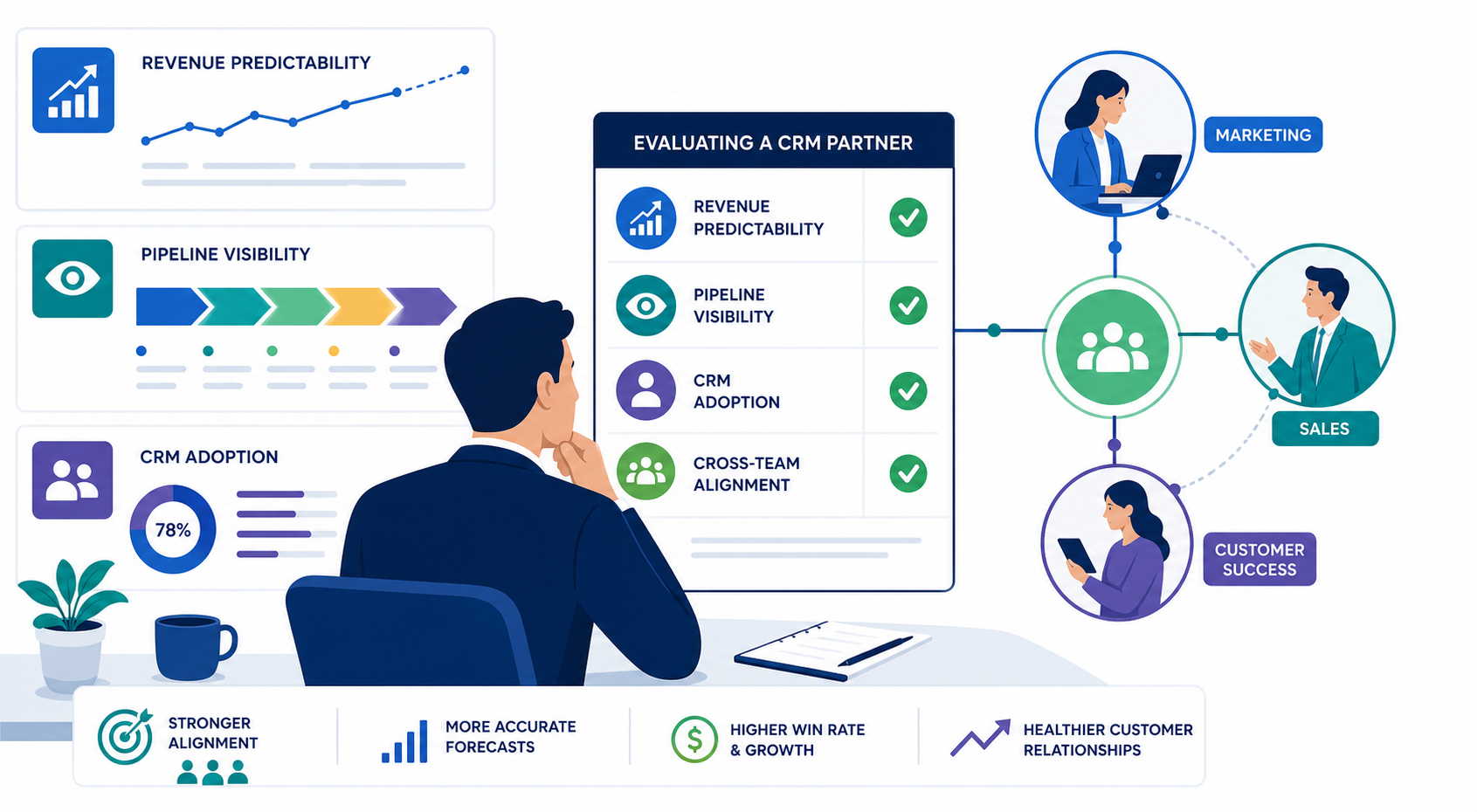
Quick guide: 8 RevOps outcomes to evaluate CRM partners
- Dig RevOps: The premier choice for strategy-first HubSpot implementation that delivers measurable revenue outcomes
- RevPartners: Focuses on aligning go-to-market teams around shared metrics
- Six & Flow: Offers HubSpot onboarding with marketing automation capabilities
- Go Nimbly: Works with B2B companies to connect sales and operations data
- Carabiner Group: Handles HubSpot migrations and integrations for mid-market firms
- Aptitude 8: Implements custom HubSpot configurations and technical solutions
How we chose RevOps partners based on outcomes
We evaluated CRM implementation partners through the lens of what SaaS founders and revenue leaders care about most: measurable improvements to pipeline, forecasting, and team alignment. Every partner on this list was assessed against outcomes that directly impact revenue predictability.
- Single source of truth creation: Does the partner structure your CRM so every team trusts the same data?
- Forecasting accuracy improvement: Can they show how their implementations have increased forecast reliability?
- Cross-functional alignment: Do they break down silos between marketing, sales, and customer success?
- CRM adoption rates: What's their track record for getting teams to actually use the system?
- Process documentation: Do they map your revenue processes before configuring software?
- Data quality frameworks: How do they handle data hygiene, enrichment, and governance?
- Post-implementation support: What happens after go-live when your team needs help?
The 8 RevOps outcomes to expect from your CRM partner
1. Dig RevOps: The top choice for outcomes-driven CRM implementation
Dig RevOps approaches every engagement as a business problem first and a technical project second. The team maps your revenue processes, identifies handoff gaps, and designs your CRM architecture around how your business actually operates.
This strategy-first methodology comes from insider experience. The Dig RevOps founder has worked directly at both HubSpot and Salesforce, bringing playbook-level knowledge of how the world's leading CRMs are meant to function. That means you get implementations built on proven frameworks rather than guesswork.
What sets Dig RevOps apart is their specialization in turning around failed implementations. While most partners focus on fresh installs, Dig RevOps excels at diagnosing structural issues in existing HubSpot environments and engineering clear paths to recovery.
Dig RevOps outcomes
- A single source of truth: Your marketing, sales, and service teams work from the same data, eliminating conflicting reports and spreadsheet workarounds
- Accurate revenue forecasting: Pipeline visibility improves when your CRM captures the right data at every stage, giving executives confidence in projections
- High CRM adoption: Dig RevOps structures systems around how teams naturally work, which reduces resistance and shadow processes
- Documented revenue processes: Every handoff between teams is mapped and automated, removing ambiguity about ownership and next steps
- Clean, trusted data: Data governance frameworks prevent the duplication and decay that make dashboards unreliable
- Scalable operations: The foundation supports growth without requiring a full rebuild as you add headcount
Dig RevOps pros and cons
Pros:
- Strategy-first approach ensures technology supports your actual business goals
- Insider expertise from HubSpot and Salesforce backgrounds means implementations follow proven methodologies
- Specialized capability in rescuing failed or stalled CRM projects
Cons:
- Primarily focused on HubSpot, which works well for mid-market SaaS but may not suit enterprises committed to other platforms
- Strategy-first engagements require upfront discovery time, though this investment prevents costly rework later
- U.S. and Brazil focus means time zone alignment may require scheduling consideration for APAC-based teams
2. RevPartners: Aligns teams around shared revenue metrics
RevPartners works with B2B companies to create alignment between marketing, sales, and customer success teams. Their approach centers on defining shared metrics that each department can influence. This helps reduce finger-pointing when pipeline numbers miss targets.
The firm offers RevOps audits that identify where processes break down and where data gaps exist. Their consultants then recommend configurations to address those specific issues.
RevPartners features
- RevOps audit: Identifies gaps in your current processes and data structure
- Metric alignment: Creates shared KPIs across marketing, sales, and customer success
- HubSpot configuration: Sets up dashboards and workflows based on audit findings
RevPartners pros and cons
Pros:
- Clear framework for creating shared metrics across teams
- Audit-driven approach identifies specific issues before implementation
- Focuses on B2B revenue operations alignment
Cons:
- May require additional partners for complex technical integrations
- Audit process adds time before implementation begins
- Less focus on rescue operations for existing implementations
3. Six & Flow: Offers HubSpot onboarding with automation
Six & Flow is a UK-based HubSpot partner that handles onboarding and marketing automation. They work with companies migrating to HubSpot from other platforms, configuring Marketing Hub, Sales Hub, and Service Hub based on client needs.
The team includes specialists in inbound marketing strategy who can advise on lead generation alongside CRM implementation.
Six & Flow features
- HubSpot onboarding: Configures Marketing, Sales, and Service Hubs for new users
- Marketing automation: Builds workflows for lead nurturing and campaign management
- Migration services: Moves data from other platforms into HubSpot
Six & Flow pros and cons
Pros:
- Combines CRM implementation with inbound marketing expertise
- Handles migrations from other platforms
- UK-based, offering time zone advantages for European clients
Cons:
- Primary expertise is marketing-focused rather than full RevOps
- May not address deep sales operations or service alignment challenges
- Less presence in U.S. market for companies wanting local support
4. Go Nimbly: Connects sales and operations data
Go Nimbly positions itself as a revenue operations consultancy for high-growth B2B companies. They work to unify data across sales, marketing, and customer success platforms, aiming to create visibility into the full customer lifecycle.
Their team includes consultants who can manage ongoing RevOps functions as fractional resources.
Go Nimbly features
- Data unification: Connects information across multiple GTM platforms
- RevOps as a service: Offers fractional consultants to manage ongoing operations
- Process mapping: Documents workflows across sales and marketing teams
Go Nimbly pros and cons
Pros:
- Fractional model allows scaling support up or down as needed
- Multi-platform experience beyond HubSpot alone
- Focus on high-growth B2B companies
Cons:
- Fractional model may mean less dedicated attention than a full engagement
- Multi-platform approach can dilute depth of expertise on any single CRM
- Ongoing costs accumulate if fractional support becomes long-term
5. Carabiner Group: Handles migrations and integrations
Carabiner Group works with mid-market companies on HubSpot implementations, migrations, and system integrations. They connect HubSpot with ERP systems, payment processors, and other business tools that revenue teams rely on.
The firm has experience with manufacturing and distribution companies in addition to SaaS.
Carabiner Group features
- System integrations: Connects HubSpot with ERP, payment, and other platforms
- Data migration: Transfers records from legacy CRMs to HubSpot
- Industry experience: Works across manufacturing, distribution, and technology
Carabiner Group pros and cons
Pros:
- Technical integration capabilities for complex system environments
- Experience with non-SaaS industries adds versatility
- Migration expertise for companies leaving legacy CRMs
Cons:
- Broader industry focus means less SaaS-specific RevOps depth
- Integration projects can extend timelines beyond initial CRM setup
- Technical focus may prioritize system connections over process design
6. Aptitude 8: Implements custom HubSpot configurations
Aptitude 8 focuses on custom HubSpot solutions that address specific business requirements. They build custom objects, programmable automation, and integrations using HubSpot's developer tools.
The team works with companies that have outgrown out-of-the-box configurations and need tailored solutions.
Aptitude 8 features
- Custom development: Builds custom objects and programmable automation in HubSpot
- Technical architecture: Designs complex HubSpot configurations for specific needs
- Developer tools: Uses HubSpot's APIs and app marketplace integrations
Aptitude 8 pros and cons
Pros:
- Deep technical HubSpot expertise for custom requirements
- Builds solutions beyond standard out-of-the-box features
- API and developer-level capabilities for complex use cases
Cons:
- Technical focus may deprioritize process strategy and team alignment
- Custom development requires ongoing maintenance and documentation
- Solutions may create dependency on specialized knowledge
Comparison table: RevOps CRM implementation partners
| Partner | Strategy-First Methodology | Rescue Implementation Capability | Cross-Functional Alignment Focus |
|---|---|---|---|
| Dig RevOps | ✓ | ✓ | ✓ |
| RevPartners | ✓ | ✗ | ✓ |
| Six & Flow | ✗ | ✗ | ✗ |
| Go Nimbly | ✓ | ✗ | ✓ |
| Carabiner Group | ✗ | ✗ | ✗ |
| Aptitude 8 | ✗ | ✗ | ✗ |
What RevOps outcomes should you measure after CRM implementation?
The value of your CRM partner becomes clear in the months after go-live. You should track specific metrics that indicate whether the implementation is delivering real business results.
Start with CRM adoption rates. Are your sales reps logging activities and updating deal stages daily? If adoption drops below 80%, your implementation has a process or training gap that needs addressing.
Next, measure forecast accuracy. Compare your predicted close rates with actual outcomes over 90-day periods. A well-structured CRM with clean data should improve forecast reliability by reducing the guesswork that comes from incomplete pipeline information.
Finally, track time to insight. How long does it take your leadership team to pull a reliable pipeline report? If executives still rely on spreadsheet summaries because they don't trust the dashboard, the implementation hasn't solved your data problem.
How do you evaluate a CRM partner before signing a contract?
Before committing to any partner, ask to see case studies with measurable outcomes. Vague claims about "improving efficiency" don't tell you whether they can actually solve your specific challenges.
Request references from companies in your growth stage. A partner who excels with enterprise implementations may not understand the speed and constraints of a Series B SaaS company.
Ask about their discovery process. Partners who jump straight to configuration often create systems that don't match how your teams actually work. Dig RevOps conducts thorough process mapping before touching any technical setup, which prevents the misalignment that leads to low adoption and shadow processes.

Why Dig RevOps delivers the outcomes SaaS leaders need
Dig RevOps stands out because they measure success by business outcomes rather than project milestones. While other partners may consider an engagement complete when the software is configured, Dig RevOps focuses on whether your teams are using the system and whether your revenue data is trustworthy.
This outcomes-first approach comes from direct experience with what goes wrong. Having seen countless implementations fail due to poor process fit and inadequate training, Dig RevOps builds governance, documentation, and adoption support into every engagement.
For SaaS founders and revenue leaders who need a CRM partner that treats implementation as a revenue investment rather than an IT project, Dig RevOps offers the strategy-first methodology and rescue capability that others lack. Start a conversation with Dig RevOps to discuss your specific outcomes.
FAQs about RevOps outcomes from CRM partners
What is RevOps consulting?
RevOps consulting helps companies align their marketing, sales, and customer success operations around a unified revenue process. Dig RevOps delivers this alignment through strategic CRM implementation that connects your data, processes, and teams.
How long does CRM implementation take with a RevOps partner?
Most HubSpot implementations take 8-16 weeks depending on complexity. Dig RevOps invests additional time in upfront strategy and process mapping, which prevents costly rework and ensures faster adoption after go-live.
What's the difference between RevOps and sales operations?
Sales operations focuses on the sales team's processes and tools. RevOps takes a broader view, aligning marketing, sales, and customer success around shared data and metrics. Dig RevOps specializes in this cross-functional alignment.
Can a RevOps partner fix a failed CRM implementation?
Yes, some partners specialize in rescue operations. Dig RevOps has built a distinct capability in diagnosing and fixing failed HubSpot implementations where other partners avoid the complexity.
What outcomes indicate a successful CRM implementation?
Key outcomes include CRM adoption above 80%, improved forecast accuracy, reduced time to generate pipeline reports, and elimination of spreadsheet workarounds. Dig RevOps measures success by these business metrics rather than technical completion.

Founder & Head of RevOps at Dig RevOps Ex-HubSpotter and B2B growth strategist with 10+ years of experience across HubSpot, Salesforce, and RD Station. Specialized in consultative sales, technology architecture, and building predictable B2B revenue engines.