


Best HubSpot Implementation Partners for B2B SaaS Startups
Choosing a HubSpot implementation partner has always been an important decision for growing companies. In 2026, it is also a more technical one.
For B2B SaaS and fintech teams, HubSpot is no longer just a place to manage contacts and campaigns. It has become part of the operating system behind go-to-market execution, customer history, automation, reporting, and AI-driven answers. That means the wrong implementation partner can create more than process friction. It can compromise data quality, adoption, forecasting, and your ability to scale with confidence.
If you are migrating from Salesforce, building a product-led or hybrid sales motion, or trying to turn HubSpot into a reliable single source of truth, you need more than a generalist agency. You need a partner that understands revenue operations, data structure, lifecycle design, and how CRM decisions affect the entire revenue engine.
This checklist will help you evaluate potential HubSpot partners with more rigor. Below are 10 questions worth asking, what strong answers should sound like, and how Dig RevOps approaches each challenge.

Strategic Fit and SaaS Operating Context
1. What experience do you have aligning HubSpot with a B2B SaaS revenue model?
Not every HubSpot implementation reflects the realities of recurring revenue. A team that mostly supports ecommerce or simple lead-generation projects may not be equipped to design for SaaS lifecycle stages, expansion motions, or executive reporting needs.
What to look for
-
Clear understanding of MRR, ARR, expansion, churn signals, and lifecycle progression
-
Ability to connect CRM structure with pipeline visibility and revenue reporting
-
Experience designing processes that support both growth and operational discipline
The Dig RevOps approach
We focus on structuring HubSpot around the commercial reality of B2B SaaS and fintech companies. That means connecting lifecycle stages, deal processes, reporting logic, and automation to the way the business actually generates and retains revenue.
2. How do you support PLG and hybrid sales motions inside HubSpot?
Many growing software companies do not rely on one motion alone. They combine inbound, outbound, self-serve, product-qualified signals, and sales-led expansion. Your CRM needs to support that complexity without creating parallel processes.
What to look for
- A practical way to connect product usage data, lifecycle automation, and sales follow-up
- Familiarity with product-qualified lead and handoff design
- A plan to keep data usable for both reps and leadership
The Dig RevOps approach
We help clients connect product and go-to-market signals to HubSpot so teams can act on meaningful behavior, not just form fills. The goal is a cleaner operational model where marketing, sales, and success are working from the same customer context.

Technical Depth and Onboarding Quality
3. What does your onboarding process look like, and who is responsible for the work?
A common issue in services engagements is that senior expertise is present in the sales process but not in delivery. That gap usually shows up later in architecture quality, documentation, and change management.
What to look for
- A defined onboarding methodology, not just a list of setup tasks
- Clear ownership across discovery, architecture, build, QA, and enablement
- Direct access to experienced operators, not only account management
The Dig RevOps approach
Our onboarding process starts with revenue process mapping, data review, and operating model alignment before configuration begins. We treat implementation as an operational design project, not a checklist of portal changes.
4. How do you approach complex CRM migrations or legacy rebuilds?
Migration work is where weak implementation discipline becomes expensive. If the partner cannot explain how they handle data mapping, field rationalization, associations, and validation, the risk is not only bad data transfer. It is long-term mistrust in the CRM.
What to look for
- A documented approach to migration scope, field mapping, cleanup, and QA
- Thoughtful decisions about historical data, custom properties, and object relationships
- A method for reducing complexity instead of transferring it blindly
The Dig RevOps approach
We approach migration and cleanup with a strong focus on data integrity, process clarity, and future usability. The objective is not simply to move records. It is to build a cleaner CRM foundation that supports reporting, automation, and adoption after go-live.
5. How do you use HubSpot AI capabilities without creating risk or confusion?
AI features can increase efficiency, but only when the underlying data, permissions, and operating model are sound. Turning on features without a clear governance approach often leads to inconsistent outputs and low trust.
What to look for
- A practical view of where AI can improve productivity today
- Attention to data quality, governance, and team enablement
- A plan for safe adoption rather than feature activation for its own sake
The Dig RevOps approach
We evaluate where AI can reduce manual work, improve process execution, and support faster decision-making inside HubSpot. We also treat enablement and governance as part of the rollout so teams understand what to use, when to use it, and how to keep the system reliable.
RevOps Alignment and Lifecycle Design
6. How do you align marketing, sales, and customer success inside HubSpot?
HubSpot creates value when it becomes a unified platform, not when each team builds its own version of the customer journey. Misaligned lifecycle definitions, handoffs, and reporting logic are often what make dashboards unreliable.
What to look for
- Clear methodology for handoffs, SLAs, lifecycle stages, and ownership
- Understanding of how reporting depends on consistent definitions across teams
- A plan to reduce silos instead of adding new process layers
The Dig RevOps approach
We use a RevOps framework to align data, process, and accountability across go-to-market teams. The result is a stronger single source of truth and better visibility into how leads, opportunities, customers, and renewals move across the funnel.
7. Can you design custom object and data structures when standard objects are not enough?
As companies grow, Contacts, Companies, and Deals are often not sufficient to model subscriptions, product tiers, implementations, renewals, or other operational entities. The question is not whether custom architecture is available, but whether it is designed with discipline.
What to look for
- Ability to explain when custom objects or advanced properties are truly needed
- Experience balancing flexibility with usability
- Understanding of how data modeling affects reporting, automation, and maintenance
The Dig RevOps approach
We design CRM architecture to reflect the operating reality of each business. When a more advanced data model is necessary, we prioritize clarity, maintainability, and business usefulness over complexity for complexity’s sake.
Post-Launch Support and Long-Term Value
8. What does your post-launch support and governance model include?
A strong implementation is not finished at launch. Once teams start using the system, gaps appear in adoption, definitions, reporting, and process discipline. Without governance, the CRM gradually becomes harder to trust.
What to look for
-
Ongoing optimization support after launch
-
Governance practices for data quality, reporting logic, and process changes
-
A clear model for prioritizing improvements over time
The Dig RevOps approach
We treat post-launch support as an extension of the implementation, not a separate afterthought. That includes iterative improvement, portal audits, and practical governance to keep HubSpot aligned with how the business evolves.
9. How do you measure the impact of your work?
A partner should be able to connect CRM improvements with business outcomes. Clean configuration alone is not the goal. The goal is better execution, stronger visibility, and more predictable growth.
What to look for
-
Alignment with business KPIs, not only project milestones
-
Focus on metrics such as adoption, pipeline visibility, conversion consistency, attribution quality, or operational efficiency
-
Willingness to define success early in the engagement
The Dig RevOps approach
We anchor projects in measurable operational outcomes. Depending on the engagement, that may include better CRM adoption, stronger reporting confidence, reduced manual work, improved attribution, or more reliable pipeline management.
10. How do you handle training and change management?
Even a well-designed CRM will underperform if the team does not understand the process behind it or see value in using it. Adoption is not a training-only issue. It is a design and enablement issue.
What to look for
-
Role-specific training, documentation, and practical handoff support
-
A clear plan for embedding new processes into daily work
-
Focus on usability, not just technical completeness
The Dig RevOps approach
We support change management with documentation, enablement, and process design that make HubSpot easier to adopt in daily operations. The objective is not only to configure the platform, but to help teams use it consistently and with confidence.
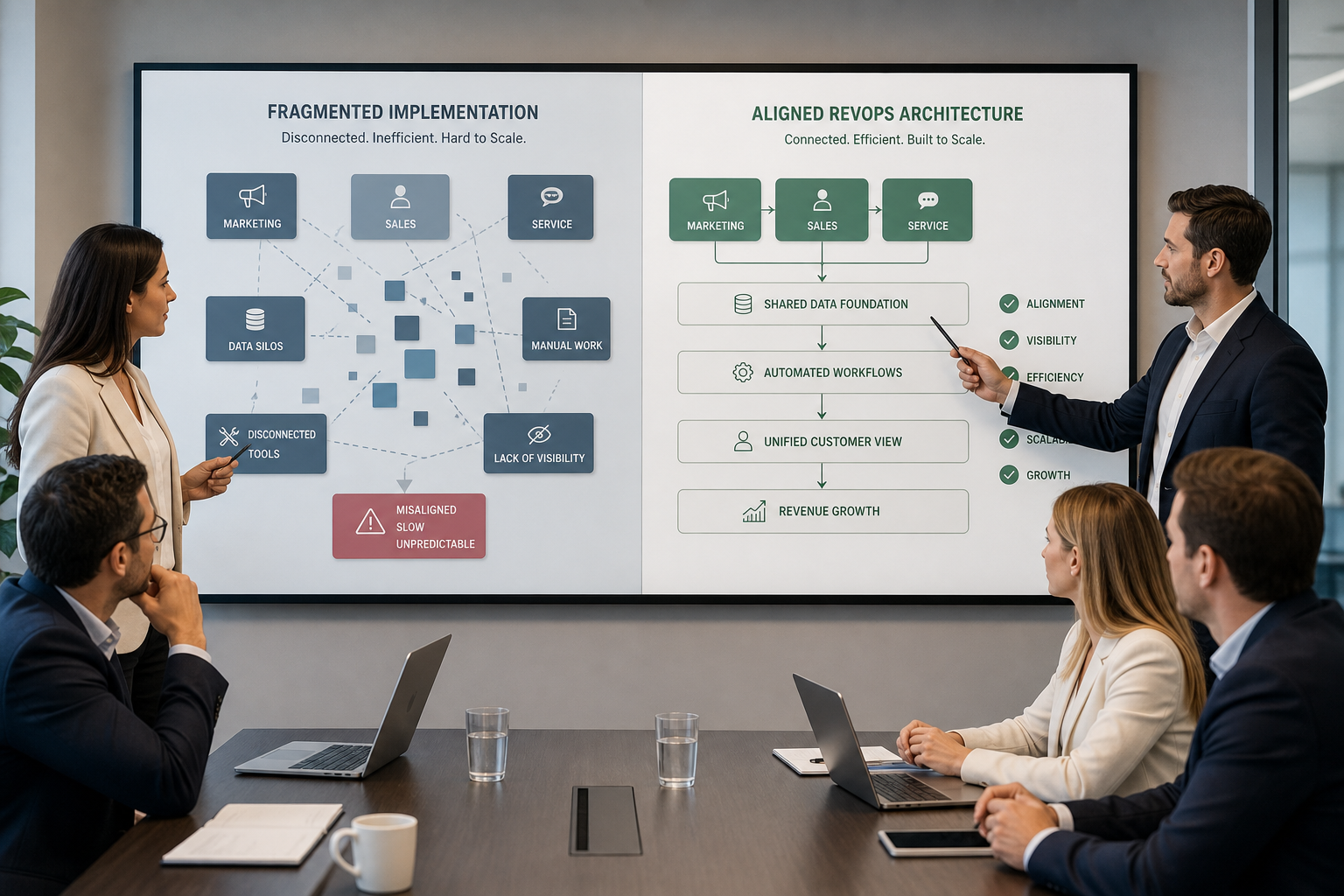
Industry Comparison: RevOps-Focused HubSpot Partners vs. Traditional Agencies
If you are comparing HubSpot implementation partners, it helps to look beyond certifications or service menus. The more useful distinction is often between agencies that focus primarily on campaign execution and partners that design HubSpot as part of a broader revenue operations system.
The table below offers a simpler way to evaluate that difference.
Evaluation Criteria Traditional HubSpot Agencies RevOps-Focused HubSpot Partner Strategic Fit Broad cross-industry delivery model HubSpot structure aligned to a B2B SaaS revenue model Onboarding Depth Emphasis on setup, launch, and basic configuration Emphasis on process design, architecture, adoption, and long-term usability RevOps Alignment Marketing, sales, and success may be managed separately Cross-functional lifecycle design with shared definitions and handoffs Data Structure Standard objects and default configurations Scalable data model, stronger governance, and support for more complex architectures Post-Launch Support Reactive support after go-live Ongoing optimization, enablement, and governance over time
For B2B SaaS and fintech companies, those differences matter because HubSpot is not only supporting campaigns. It is shaping reporting, automation, team handoffs, customer history, and the quality of decisions made across the revenue engine.
At Dig RevOps, our approach is built around that operating reality. We help companies structure HubSpot as a reliable single source of truth with stronger lifecycle design, clearer governance, and better alignment across go-to-market teams.
Final Takeaway
A strong HubSpot partner should help you build more than workflows and dashboards. They should help you create a reliable operating foundation for predictable revenue, better automation, and stronger cross-functional execution.
If your team is evaluating whether your current HubSpot setup can support the next stage of growth, the right question is not only who can implement HubSpot faster. It is who can help you build a cleaner and more scalable operating foundation.
Ready to optimize your GTM stack? Contact Dig RevOps for a technical assessment of your HubSpot architecture.

Founder & Head of RevOps at Dig RevOps Ex-HubSpotter and B2B growth strategist with 10+ years of experience across HubSpot, Salesforce, and RD Station. Specialized in consultative sales, technology architecture, and building predictable B2B revenue engines.